A Holiday Wish
After years of distraction — and the past eleven months of lawless mayhem — there are glimmers of an awakening, and with it, hope for a better tomorrow

This is our last essay for the year. We are going to take — and give everyone — a week off from the Substack for the holidays. We’ll be back with our usual Monday morning postings in January. We have a lot planned for 2026, including continuing coverage of what’s turning out to be a big sentencing term at the Supreme Court, a greater focus on the work of state sentencing commissions, some new interviews, more thoughts on teaching sentencing, continued commentary on the second Trump Administration and how it’s changing our republic, and maybe a few surprises too.
While we take time away for the holidays and hopefully enjoy it with friends or family, we should keep in mind that not everyone has that privilege. We ought to remind ourselves, if only for an instant, that as we sit down with our loved ones, there are hundreds of thousands of men and women who, at that very moment, are mourning family members lost to crime, hundreds of thousands of men and women spending the holidays serving sentences in prisons and jails, and hundreds of thousands of men and women working the holidays to keep us safe. God bless them all. And our best to all of you and your loved ones for a wonderful holiday season and a joyous 2026.
- - -
2025
This was the year we began to reclaim and refocus our attention. Someday, we might very well look back at 2025 and see it as a genuine inflection point. It was a year when we started to more fully understand how deciphering distraction from what we genuinely value deep in our souls is an essential skill these days — maybe the essential skill — one that if mastered, can help us keep, or maybe regain, our bearings and our sanity. And if we do that, maybe we can create a better future for ourselves and for others.
It was another year when our President, along with Silicon Valley billionaires old and new, remained hell-bent on constantly stirring our emotions for the own benefit, on keeping us distracted. But this year, they faced just a bit more friction, if not quite blowback. With his book, The Siren’s Call: How Attention Became the World’s Most Endangered Resource, released in January, Chris Hayes reminded us of what was in plain sight for years and yet so hard for us to see. In such a short time, our phones and their apps, through clandestine and devilish engineering, had warped our minds, our choices, our lives. Like much that has come out of Silicon Valley, we were so easily taken by the shiny new objects. We were enthralled when Steve Jobs said during his 2007 Apple keynote, “Every once in a while, a revolutionary product comes along that changes everything.” We couldn’t wait to get our hands on it. And then the next version. And the next.
The revolution Jobs envisioned took more than a decade to play out. We rejoiced over — and then soon enough took for granted — the wonder of carrying in our pocket every book, every song, just about every store we might want to shop at; of being able to know in an instant every high school basketball player from Long Island who averaged 30 points per game over a season; of having at our fingertips the weather, the traffic, listings of homes in our neighborhood for sale, the bid and ask prices of every stock, option, and derivative at each and every moment of the day, the betting odds that the sixth man on the Wizards G-League team would score more than five points that night, and the stream of thought, together with promotional images and video, of anyone — and its almost everyone — who chooses to be on social media. Of course, we surmised all along — but were in denial — that for many, the wonder comes with greater anxiety, social isolation, falling academic test scores, lost social skills, and cyberbullying of every conceivable kind.
With the inauguration of President Trump, a man genuinely of his time, to his second term at the start of the year, the bombardment on our attention worsened. Especially for those of us for whom public policy is either a vocation or a religion, the shock and awe that began on January 20th was genuinely disorienting. But what made it chilling, too, was the undeniable cruelty that accompanied the barrage of invective and policy and just plain dictatorial orders. Of course, the whole idea of shock and awe is to get us to accept and surrender to cruelty, madness, and dictatorship.
It wasn’t just our attention that was under attack. Jobs once reminded us that “[s]ometimes life hits you in the head with a brick.” This was also the year that bricks were flying all around us, all the time, many of which were launched by an imperious and brutal President and enabled in the shadows by the Supreme Court. Some of us were just nicked by them once or twice. But in the first eleven months of the Trump Administration, many of those we care about — and many whose names we will never know — were hit squarely by the President’s decisions. Tariffs, layoffs, deportations, terminations, the shutdown, missile strikes, masked agents patrolling our cities, the end of USAID, and so much more. When that happens — and when it’s not clear you’ve been hit for last time — doubt, fear, loss of faith, and worse come next. For those of us fortunate enough not to be in the direct line of fire, our first job was to console and try to aid the wounded. The organic reaction to all this for so many was despair and distress; it’s the reaction the President wanted.
Coming to our senses
My children were in middle and high school when smartphones spread across our culture. We — their parents and school leaders — missed our responsibility to step in. Stepping in is what parents and school leaders are supposed to do. That miss is just one in a long line of generational failures we’ve made that have left many of our children in difficult circumstances. But we eventually learn. As Churchill said, Americans can always be trusted to do the right thing, once all other possibilities have been exhausted. Perhaps only by dint of underachievement and mass levels of anxiety and loneliness, something has started to change. In 2025, we started to come to our senses.
This year, schools across the Country banned cell phones from bell to bell. The reports coming from these schools are promising, with student anxiety down, in part because they aren’t afraid of being filmed at any moment and embarrassing themselves, and participation and concentration are up. States are passing laws banning social media for young kids. Australia just banned it for kids under 16. Among my kids’ generation, buying dumb phones or using a “brick” has become a thing. Talk is beginning about the Right to Disconnect. More of us are taking digital detoxes, setting stricter boundaries, and even choosing activities that don’t require screens (our family bought a board game this year). Boredom is making a bit of a comeback. So too, hobbies, family, and our own thoughts.
And when the AI robots invaded this year, they were greeted not as conquering heroes but with more than a little skepticism. Chat GPT may have rolled out a few years ago. But with the data center buildout, the hyperscalers gone wild, NVIDIA becoming a $5 trillion company — by comparison, the GDP for the entire United Kingdom in 2025 is projected to be approximately $3.9 trillion — the explosion of AI Instagram influencers, AI agents popping up in industry after industry, and so much more, 2025 brought a new techno-revolution upon us.
But unlike with the introduction of the iPhone, Americans faced the robot invasion with great suspicion and more than a little dread. According to various surveys, Americans are much more concerned than excited about the increased use of AI in daily life. Most people are saying they want more control over how AI is part of their lives. Far more people think AI will erode rather than improve people’s ability to think creatively and form meaningful relationships. It seems we are learning.
For the President too, there was more and more skepticism of his act as the year rolled on. What the President didn’t realize was that his never-ending clown show was simultaneously sowing the seeds of an awakening, including from the technologically driven trance we have been in for so long. Across the first few months of the new Administration, there were some whose reaction to President Trump was not despair but rather to fight and those who kept their heads and their faith in the fundamental goodness of our Country and its people. As we said in an essay on fear and loathing “in the Ministries” back in February, our myths, heroes, and history have taught us not just to keep faith . . . they remind us when it’s time to fight.
But for most of the Country, it would take more time. When we are entranced — and much of the Country was — we allow our illusions, about technology and about politics too, to continue on because they seem to serve us, at least in the short run, and give us plausible deniability of our own responsibilities and excuses for not doing the uncomfortable. But there comes a time when the illusions give way — there’s only so long the clown show remains funny — when we have no choice but to pierce the bubble and face the truth.
Over the year, there has been a slow realization for just enough of the Country of what the President and his subordinates have been doing, not just to all the “others,” but to each of us and to the Country itself. I’m not sure why, now, many of the President’s supporters seem to be distancing themselves just a bit from him; why the killing of those shipwrecked after Trump’s boat attacks struck a sufficient chord for some Republicans to voice concern; or why the treatment of Republican women in Congress by Speaker of the House Mike Johnson is now, only now, alarming to them; or why the Indiana Senate, four-fifths Republican, defied President Trump and his redistricting plans; or why the increases in the cost of health care for millions now warrant some public Republican worry. But something has happened and something is happening. As a fog lifts, some of our brothers and sisters seem to be finding a bit of their own virtue and a bit of the Country’s too.
The President’s act is wearing thin. Even Marjorie Taylor Green thinks so. All the action, the drama, the loud noise, the calls for retribution, the ICE raids; they can be entertaining and amusing, even enjoyable when the target is the other team. But they can only mask the incompetence, corruption, and cruelty for so long. When misplaced attention is refocused — because we, or our loved ones, or our neighbors, or the guy who cuts our grass are starting to get hurt; or because of sickening comments about a man and his wife just brutally murdered; or because the act is just running stale — what’s behind the mask begins to appear. Pete Hegseth is no Bob Gates. Robert Kennedy Jr. is no Joe Califano. And when it happens, some of us start to question what we had been so sure about: who is the wicked and who is the good.
Reclaiming our economy, too
I taught sentencing and an AI class at Stanford this fall. When you’re at the epicenter of the revolution, nearly every conversation you overhear — around the table at the student union at Tresidder or at the farmer’s market on California Street — is inevitably about AI. The engineers and would-be entrepreneurs have wide eyes about how their startups will change the world and make them billions. And so it should be, for our country is better off with some of us dreaming big.
But the awakening that began this year that is leading us to better decipher and commit ourselves and our attention to what really matters is also about coming to grips with the hyper-capitalism that the silicon chip has made real and with what the billionaires are doing to us. The word of the year has been affordability. But despite all the fascination with Zohran Mamdani and the fixation with socialism, those focal points seem misplaced. If everything we need to know we learned in kindergarten, yes, one of those things is sharing. It’s embodied in policy less than it ought to be. But we have also been letting the algorithms deny us that sharing more and more. They are pitting us ruthlessly against each other. They enable and help drive our winner-take-all economy.
When Mamdani, a huge fan of the English Premier League and the Arsenal Gunners, took on the cost of World Cup tickets, it was the dynamic, algorithmic pricing that especially caught his eye. “I have long been quite troubled by how the supposed stewards of the game have opted for profit time and time again at the expense of the people that love this game,” said Mamdani. “And I think what is stunning to me is these demands that we are putting forward, they are just demands that go back to what [FIFA] has done in previous World Cups.” FIFA relented last week. We can do this.
It seems to me the real fight is not capitalism v. socialism. It’s algorithmic, soulless, and oligopolist hyper-capitalism v. a more human, more equitable kindergarten capitalism. Edmond Burke said that “If we command our wealth, we shall be rich and free; if our wealth commands us, we are poor indeed.” Just as we are starting to reclaim and refocus our attention, political and otherwise, it seems that in 2025 we started to think about better commanding our wealth too.
A holiday wish
What I love about teaching is that when you do it well, there are meaningful human connections made among the students and between the students and the teacher. It happens in-person, in real-time, before our very eyes. And when it happens, you can see it in the students’ eyes, and you can feel it in the classroom. Even in the heart of Silicon Valley, at Stanford, the yearning for human connection is real. It is what matters and part of where we are refocusing.
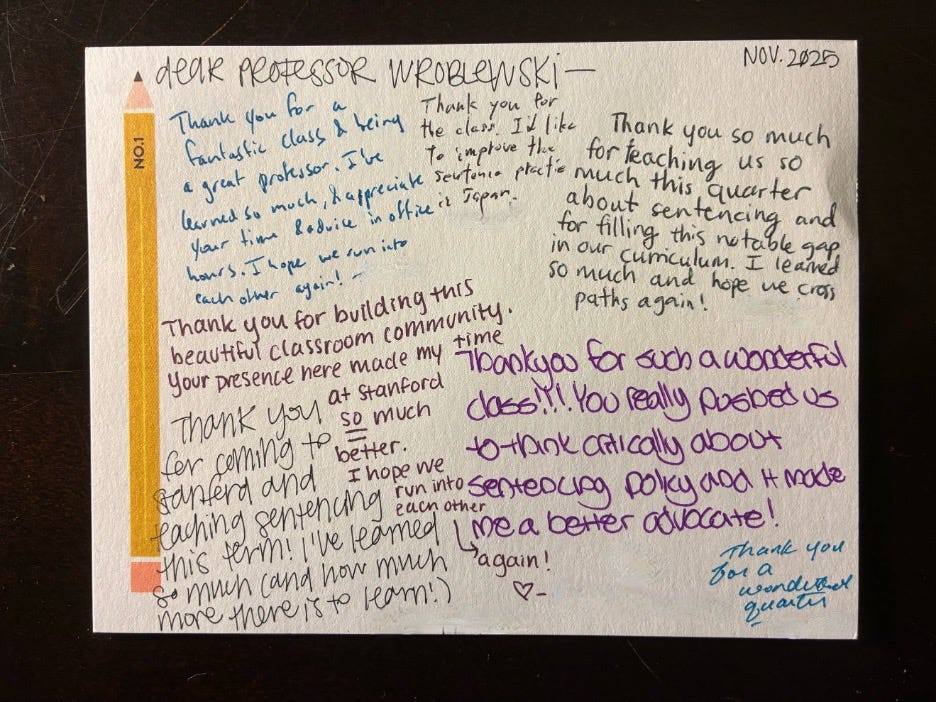
On the last day of class in November, the students in my sentencing class handed me a small card. It was just one moment in time; a dozen or so young people choosing to direct their attention and generosity toward another human being. Mementos like it are a reminder of what matters: to be surrounded by people who see you and care for you, to find moments of peace and joy and gratitude and togetherness even when the world is very loud and we’re all very busy.
Our class — of real people coming together at a particular time and in a particular physical place twice a week for 90 minutes — was a small but stubborn act of resistance to the engineered distraction that has defined so much of our world recently. It is proof of concept — if ever we needed it — that meaningful human connection still can break through: in a classroom where students lift each other up, in a family that puts the phones away for a board game, in neighbors who show up when someone is struggling, in a country that rejects cruelty and embraces the Golden Rule, in its government and in its economy, and in a simple note that says, “you matter to me.”
In the coming year, I wish — for me and for you and for all of us — that we continue to reclaim our attention, our politics, our economy, our souls in ways that make more room for human connection and that bring us all just a little closer together. Happy holidays!