
The Sentencing Matters Substack Book Review: The Science of Second Chances, by Jennifer Doleac
Imagine if economists ran national crime and sentencing policy, rather than lawyers and politicians

Last week, Apple held its 2026 Worldwide Developers Conference (WWDC), the last one presided over by outgoing CEO Tim Cook. As usual, Cook and his colleagues announced new products and new features for existing ones. The point of these conferences — Apple’s and every other major tech company’s — is to wow us, to convince us that the next wave of technology will make our lives easier and better in ways we never imagined. And most of us are suckers for it.
We are creatures of habit, living most of our lives on mental autopilot — what Behavioral Economist Daniel Kahneman called System 1. When something genuinely new rattles that inertia, our emotions light up. Sometimes the response is awe and wonder; sometimes it’s fear and dread.
Before long, though, the thing that once shook us becomes the new normal. Watch an old WWDC keynote. The technologies that seemed miraculous then now feel mundane. What once wowed us has become background infrastructure. We move through our days using what was revolutionary just a short time ago without any sense of wonder at all. Comedian Louis CK once joked about a man on an airplane complaining that the Wi‑Fi wasn’t working. “You’re flying in the air like a bird,” he reminded the man, “partaking in the miracle of human flight at 500 miles an hour in a metal tube.” Oh yeah. I forgot.
For fifteen years at DOJ, a big part of my job was figuring out how the march of new technology required us to adjust federal criminal justice law and policy. Almost every innovation that can improve our lives can also be used to commit, investigate, or prosecute crime. A car can take a robber to the bank. A phone can coordinate a fraud. A computer can be used to access child pornography. Doorbell cameras can identify thieves. Social media data can map a criminal network. And the phone in your pocket is tracking your every move.
Many of these technologies feel old hat now; we’re used to how they’re employed for good and for harm. When two conspirators plan their scheme over the phone today, the phone part doesn’t get our attention or stir our emotions. But when technologies are first introduced and used by criminals, they often rattle us.
Take the arrival of personal computers and the Internet, and the way they transformed the distribution and consumption of child pornography in the 1990s and 2000s. We were spooked — and understandably so. The lawyers and politicians who dominate crime policy making reacted as you might expect, in line with their training and experience.
They aimed mostly to address the public’s emotional panic, but also, they thought, to solve “the problem.” There was a political imperative to act, and so they did. Their actions followed a familiar pattern: a memo, a press conference, proposed legislation, and an enforcement initiative. After all, that’s what lawyers, lawmakers, and political operatives do. And in the proposed legislation, a new crime, higher penalties, fresh enforcement tools, and a directive to change the sentencing guidelines.
The child pornography law that was enacted produced this sentencing enhancement, among others:
If the offense involved the use of a computer or an interactive computer service for the possession, transmission, receipt, or distribution of the material, or for accessing with intent to view the material, increase by 2 levels.
At the time, using a computer felt like something special — futuristic, threatening. Today, even though each of us carries a computer in our pocket and using one is no more remarkable than using the bathroom, the enhancement remains.
The pattern of new technology, then new crime legislation — often including penalty increases — has played out over and over. When fraud migrated from the mail to the phone and other telecommunications technologies in the first half of the 20th Century, Congress created the wire fraud statute. When automated dialing was first used for mass marketing scams, Congress passed telemarketing legislation and with it a new guideline enhancement. When those same scams migrated to spam email, another law and another enhancement. On and on.
More recently, in 2024, Deputy Attorney General Lisa Monaco warned of the dangers from the misuse of artificial intelligence to commit crimes, and the Department asked the Sentencing Commission for a Chapter Three enhancement. And just a month or so ago, the Commission floated a six‑level enhancement for crimes committed using drones — a change that would effectively double the otherwise applicable guideline penalty. On and on.
- - -
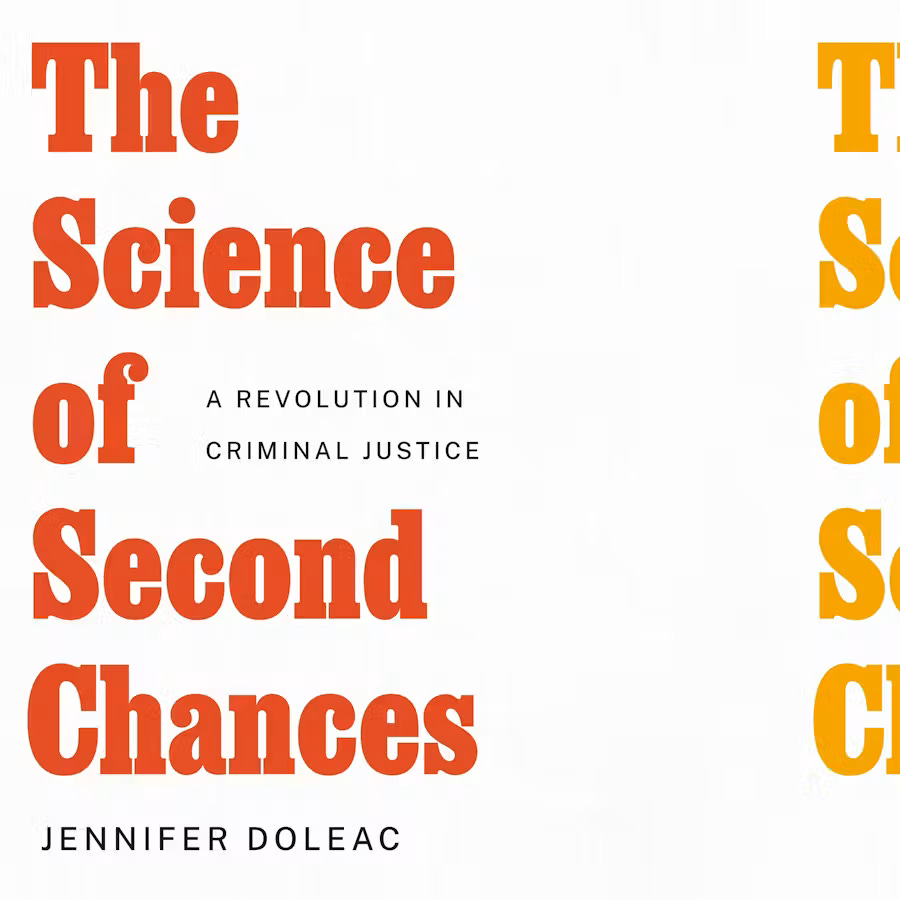
In her book, The Science of Second Chances: A Revolution in Criminal Justice, Jennifer Doleac, a Stanford-trained economist and Executive Vice President of Criminal Justice at Arnold Ventures, asks us to imagine a very different approach to crime problems, whether they be acute or enduring, technologically driven or otherwise. What if instead of lawyers, politicians, and political appointees, she has us wonder, federal crime policymakers were economists. In such a world, the first instinct — and the pattern of reaction — would be a far cry from what we now experience.
Doleac lets us in on the world of economists and how they think. Faced with the rise of online child pornography or AI‑enabled fraud, an economist’s starting point would not be, “What new law or enhancement will show everyone we’re serious and deter the crime?” but a series of unglamorous questions: Does this technology increase crime, or just change the way it’s committed? By how much? For whom? How? What tools already on the books and available work just as well in this new setting? If we do add a new penalty or investigative power, what evidence do we have that it will actually deter or otherwise reduce crime, rather than simply increase punishment after the fact, cost the public a lot of money, and inflict pain on the convicted and her family? What other steps — enforcement or otherwise — could we take to reduce the behavior we’re concerned about?
Crucially, Doleac tells us, the economist would insist on treating their own ideas as mere hypotheses, not moral imperatives or self-evident truths. One of the central themes of Second Chances is that criminal justice policy making can look more like a science lab and less like a press or political office, and when it does, the results will often be less crime at lower cost. Doleac walks through example after example in which policies that sounded tough or compassionate or “common sense” turned out, once tested, to have no effect on crime — or even made things worse. She shows how economists use randomized trials and natural experiments — staggered rollouts, eligibility cutoffs, geographic borders — to separate what we think a policy does from what it actually does in the world. The goal is sound policy: less crime, more justice, at less cost.
It all may sound abstract until you look at the kinds of studies Doleac highlights in the book. One set of researchers partnered with New York City to tackle a dry but important problem: people who receive summonses and then simply don’t show up for court. Those failures to appear lead to warrants, arrests, and deeper entanglement with the justice system. Instead of jacking up penalties, the researchers redesigned the paper summons and then ran a randomized controlled trial of text‑message reminders. The new form alone cut failures to appear, and targeted reminder texts reduced missed court dates even further. No new crimes or enhancements were necessary. Just better forms and a few cheap text messages.
Doleac points to a growing body of randomized trials on something as mundane as summer jobs for teenagers. In city after city, when at‑risk youth are randomly offered a modestly paid summer job — nothing glamorous, just part‑time work with some mentoring — violent crime among those teens drops dramatically (and so do deaths due to violence). Effects, it turns out, persist and even increase long after the summer ends. Economists don’t assume why this works; they measure it. The effect is big enough, and replicated often enough, that “hire teens for the summer” now looks like one of the most cost‑effective violence‑reduction strategies we have.
These are not headline‑grabbing policies, poll-tested for political salience. They are small tweaks, tested for effectiveness, that quietly change behavior at the margins. And that is precisely the point of Doleac’s book.
In a Department of Justice run by economists, the response to a new technology wouldn’t begin with drafting a new law or sentencing enhancement; it would begin with hypotheses and designs for evaluations. If AI tools make certain frauds easier to pull off, the economist’s instinct is to ask whether increasing the certainty of detection, for example — through better analytics, better reporting systems, targeted AI tool redesign, smarter audits — would do more to reduce victimization than simply ratcheting up the sentence if someone happens to get caught. If drones create new ways to smuggle drugs into prisons, they would test whether narrowly targeted interdiction efforts or changes to prison routines might actually cut off those channels before defaulting to a blanket six‑level increase in the Guidelines.
That mindset also changes how you think about “new” versus “old” technology. The two‑level computer enhancement for child pornography may have made some emotional and political sense in the early days of dial‑up; it felt like we were punishing something especially dangerous and modern. We all look at the same enhancement today, in a world where everyone uses computers, and see a factor that no longer explains anything. In Doleac’s terms, it’s a policy that was never rigorously tested and is now plainly out of step with how people live.
In a science‑driven DOJ, the question wouldn’t be, “How can we signal that we take this seriously?” It would be, “Does this factor predict risk or deter crime and is this proposed intervention effective?” Even if the political imperative to act drives some immediate performative response that includes a penalty increase, the economist would make sure that the increase included a sunset clause, ensuring that it would be reviewed again later when the emotional tug of the technology was no longer as strong and the data on its effectiveness was collected and analyzed.
Doleac’s book is, in many ways, an extended argument for building a criminal justice system around that kind of disciplined humility. Most people in the system, she reminds us, are not masterminds. They are repeat, low‑level offenders whose lives are already on the margins and often chaotic. The policies that matter most for public safety are often not the dramatic ones that yield good talking points, but small, well‑tested interventions that quietly change incentives at key decision points: text reminders that keep people from missing court and picking up warrants; summer jobs that keep teenagers occupied and out of trouble; reentry supports that make it more likely someone leaving prison can succeed instead of returning.
Economists, by training, are obsessed with measuring those marginal changes. Lawyers and politicians, by training, are obsessed with telling the right story. Imagining economists in charge of national crime policy is, in that sense, imagining a different kind of policymaking. It’s one in which a new technology — or a new crime panic — doesn’t automatically produce a new statute or a higher guideline, but a demand for evidence: What do we know? What don’t we know? How can we learn quickly and adjust when we’re wrong?
This is where my mind wonders back to the Apple developers conference. Each year, Apple doesn’t just unveil shiny hardware; it releases a new version of its operating systems. There’s always a list of changes: bugs fixed, security holes patched, features added, old code eliminated. Some updates are big, some are minor, but the assumption is that the system is never finished. The job is to keep iterating.
Doleac helps us imagine the equivalent of an annual “Justice Developers Conference.” It could be a gathering not just of criminologists or economists — those gatherings actually already take place now — but one where DOJ, other federal and state policymakers, sentencing commissions from across the country, legislators and their staff, and others gather with economists and criminologists not to announce the latest crackdown, but to discuss research and roll out “Criminal Justice 17.0” — a set of evidence‑based updates:
This diversion program was tested in three cities and cut new charges in half for eligible defendants, so we’re expanding it.
This sentencing enhancement for commonplace technology no longer explains any variation in risk, so we’re retiring it.
This reentry program that sounded great on paper didn’t move rearrest rates at all, so we’re sunsetting it and reallocating funds.
Not just an amendment year presided over by lawyers and judges that ends in a new 2-level enhancement or 2-level reduction; but an annual conference of size and scope and of research-driven collaboration and policymaking.
The Science of Second Chances is Doleac’s case that if we built our policymaking apparatus around that kind of update culture — if we let the lab, not the podium, drive policy — we would likely end up with a system that is both safer and cheaper and also far more generous with second chances than the one we have now. In a world where our phones get a security patch every month or so, it shouldn’t be too much to ask that our crime policy get regular evidence-based and field-tested updates too.
Writing from inside federal prison, I appreciate the book’s insistence on evidence over slogans. But in the Bureau of Prisons, a major problem is that many “programs” are not true programming at all.
Too often, they are classes offered so the institution can say they were offered. Staff check the box. Participants complete them for credit. On paper, it looks like rehabilitation. In practice, it can be little more than compliance theater.
Inside, people often call this “fluff.” That usually means the class lacks depth, skilled facilitation, empathy, accountability, or any serious relationship to change. Sometimes the staff do not believe in the material. Sometimes the participants are there only for credit. Everyone gets through it, the paperwork is done, and the system calls that programming.
That distinction matters. If researchers, policymakers, and the public talk about “prison programming” as if it is one meaningful category, they may miss what is actually being delivered inside the institution.
The question is not only whether programming works. The sharper question is whether what prisons call programming is substantive enough to deserve the name.