
The Sentencing Matters Substack Interview: Investigator, Artist, and Activist, Maureen Kelleher
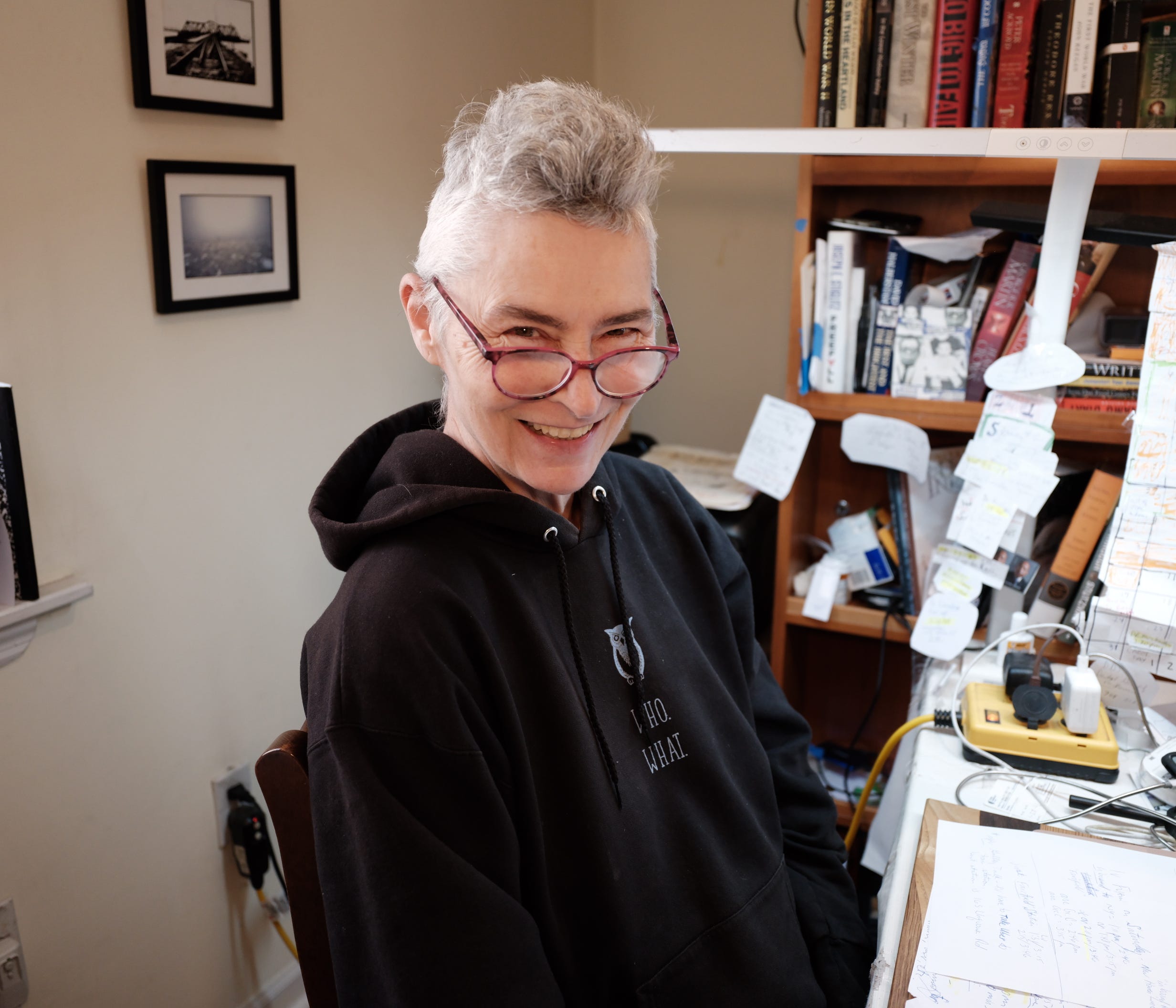
A hopeful, energetic person, Maureen has an instinct for grace, and she has shown it to the men serving life imprisonment at the Angola Prison in Louisiana

Maureen Kelleher is an accidental activist. She studied philosophy in college and stumbled into a job as a criminal investigator. While living in New Orleans and doing that work, she met Kenya Baleech Alkebu, who was — and still is — serving a life sentence in the Louisiana State Prison in Angola. Kelleher and Alkebu shared an interest in drama — Alkebu was in the drama program at Angola — and the two stayed in touch when Kelleher moved to New Jersey after Hurricane Katrina. Later, Kelleher and Alkebu co-founded the Social Justice Collaboration Quilts Project to help raise awareness of the lives of the men in Angola and their efforts to stay active, find purpose, be creative, and stay engaged in the world while serving life sentences in prison.
I spoke with Maureen in late April over Zoom. The interview has been edited for length and clarity.
This is the second is a series of posts on Holy Week 2026. For more on the Social Justice Collaboration Quilts Project, check out the first post in the series.

- - -
Jonathan: Thank you so much for sitting down with me. Could we start with you telling us a little bit about where you grew up and what that time of your life was like?
Maureen: My father was in the military. He graduated from West Point, and about 13 or 14 years after he graduated, he was assigned to West Point and taught there. That’s where I was born in 1959. I was my parents’ 8th child. We later moved to North Carolina, and I started elementary school at Fort Bragg.
A few years later, my father retired from the Army, and we moved to Denver. My parents divorced, and I ended up moving to Texas, and then California, and then Florida, all to live with my sisters. I lived in Austin, Texas, then San Francisco for a year, and then, Hialeah, near Miami, in Florida for the last couple years of high school. I graduated from the University of Florida with a degree in philosophy.
Jonathan: How did you end up a criminal defense investigator.
Maureen: I took my useless degree in philosophy, and I moved to New Orleans. I just did odd jobs there for a long, long time. I was also doing some volunteer work, and I ended up volunteering for Amnesty International on a case where a young African American teenager had been framed for murder right outside New Orleans.
I’d never done anything political before that. I’d never even signed a petition. But I heard this civil rights attorney talk about this case, about how this Black teenager was charged with killing a 13-year-old white high school student during a race riot at Destrehan High School in St. Charles Parish. And so, I was listening to her talk about the riot and what happened, and she had pictures from the actual day of the riot. It was just like, “wow — I’ve seen this stuff on TV, like To Kill a Mockingbird.” I’d heard about African Americans getting railroaded for killing white people, but here I was now in the middle of the real deal. I was just taken with it. So, I talked to the lawyer after her talk. I’d never talked to a lawyer before. I didn’t know lawyers. She was a woman, and I’m like, “wow — she’s really cool.” So, I ended up volunteering for the Committee to Free Gary Tyler. I was hooked.
Jonathan: What did you do on the case?
Maureen: I did posters, and petitions, and meetings, and benefits, and t-shirts, the whole nine yards. I just jumped in with both feet. I really didn’t have any kind of career path or anything. One day, I mentioned to the lawyer — her name was Mary Howell — that I was thinking about studying paralegal studies. That was the only thing I could think of that would interest me.
Mary was a civil rights attorney. She specialized in police brutality cases. She represented the families of men who died in jail. She’s a kick-ass civil rights attorney. Because a lot of her cases involve people who died in jail, she often used a homicide investigator. She mentioned to her investigator that I was looking for a job or a career, and out of the blue one day, he just asked me, “do you want to work with me?” And I said, “yeah.”
Jonathan: That’s it?
Maureen: Yeah. You don’t go to school to be a private investigator. He took me under his wing, and he trained me how to be a criminal fact investigator. This was about 1992. I was in my early 30s. He would just tell me what to do . . . like, this is why you need to go talk to this person. He told me to just get them talking about stuff. So, I would. He took me one time out with him on an interview at a coffee shop. I ended up doing interviews on rape cases, murder, bank robberies, just really big, heavy-duty stuff . . . and capital murder, because he did a lot of capital murder cases, too.
Jonathan: Were you nervous doing this kind of work?
Maureen: I would get a little nervous at first about whether they were going to talk to me? I would walk up to the front door, maybe have some butterflies, and knock on the door. As soon as they would open the door, I’m like, “oh, hi, how you doing, blah blah blah.” I think my kind of carefree attitude, and just being down-to-earth, simple, kind, would do the trick. It really works. Most people want to tell their story. Most people are really good. So that’s how I became an investigator. I worked for really good criminal defense attorneys. I just hit gold. As soon as I started, it was obvious this was my kind of work.
Jonathan: How did you first meet Kenya?
Maureen: Through my investigation work, I would be up at the prison now and then to interview people, whether it be the co-defendant, or the main witness against our guy on death row. I would usually go up to the prison, like once a year. While I was there, I would sometimes watch the drama club perform. The first time I went was with the civil rights attorney I worked for. Every December she’d get invited to the drama club banquet, and anybody could go. So, she said, “who wants to go?” I’m like, “I’ll go.”
The drama club event was in the very big main visiting room. During breaks in the performances, you could talk to anybody you want. It was really amazing. That’s when I first met Kenya. Gary Tyler, the guy from that first case I volunteered on with Amnesty International, he was the president of the drama club. Kenya was also doing drama. That’s how I met him.
Jonathan: Before we talk about quilts and your work with Kenya, how did you end up in the New York area working for Legal Aid?
Maureen: It was in 2005, and it was because of Hurricane Katrina! I had lived in New Orleans for 23 years. I was super happy, loved my job, loved my apartment. I had turned my apartment into an art studio, where I cut and sanded and grinded and painted wood and sawed. The Saturday before Hurricane Katrina hit, I had my TV on listening about the hurricane. I was like, “forget it, I’m not leaving.” But then about 9 o’clock at night, the National Hurricane Center guy, Max Mayfield, came on, and he said, “New Orleans, you’re going down. This is it. This is the big one.”
And he said, “go, don’t waste any time.” So, I called a couple of girlfriends, and I said, “this is gonna be bad. Let’s go.” One girlfriend said, “okay, I’m with you.” Another girlfriend was a nurse at a nursing home. She said she was staying around.
Around midnight, my friend drove to my house, I got in my car. I followed her in her car. She had her three cats in her Toyota Corolla, and I had my purse, and I think I grabbed, like, a pair of socks or something. I had almost nothing. And off we drove. Around 9, 10 o’clock that next morning — we’d been driving all night — we pulled off on an exit and got the last hotel room in Oxford, Mississippi. We stayed there for about three nights, and then she got in her car and headed east, because she had family in Alabama. I just continued north, where my boyfriend at the time was living in Hoboken, New Jersey. It took me, like, two more days, and I landed in Hoboken. I’ve been here for 21 years.
Jonathan: How come you stayed in Hoboken?
Maureen: When I was in New Orleans, I was making art and sending it to art shows in New York and trying to get my art exposed. I wondered then what it would be like to live in New York. So here I was in Hoboken, and I thought, well, I’m here. Why don’t I just give it a go?
Jonathan: What happened to being an investigator?
Maureen: For a few years, I just played around and made art. I had some savings, and I was just up in the studio all the time. And then I had to get a job. I tried like heck to get work up here with capital or criminal defense attorneys, and I couldn’t get one. I had worked on Kyles v. Whitley and the exoneration of John Thompson. I eventually did some work for the Innocence Project and then I got hired by Legal Aid, where I’ve been for the last 11 years.
Jonathan: Did you stay in touch with Kenya and others back in Angola?
Maureen: I left New Orleans in ‘05 because of Katrina, and was writing letters back and forth with Kenya. We were always in touch. The inmates in Angola had access to email, so staying in touch was relatively easy.
Jonathan: When did the quilting start?
Maureen: The first time I heard about the quilts was when I was doing an interview at the prison years before. I came out of a prisoner interview, and the security guard came up to me, and he said, “do you want me to go get Gary Tyler,” because he knew I had been an activist on Gary’s case. I said, “sure.” So, like, two minutes later, here comes Gary Tyler. I was like, “hey, Gary, how you doing?” And he said, oh, “you know, Maureen, we’re making quilts.” And I thought, wow – that’s interesting.
Fast forward to 2012, I’m on the phone with Kenya, and he mentions quilts, and I’m like, “what do you mean, quilts?” He’s like, “the hospice volunteers, we make quilts.” I said, “hospice? What do you mean, hospice?” He said, “yeah, we have a hospice program up here at the prison. We take care of the dying prisoners.”
“That’s incredible. Now what about the quilts?” And he said, well, “we make quilts, we sell quilts that we make to raise money for the program.” I said, “oh my god, this is fucking unbelievable!” I told him that people have to learn about this. And that’s how we started the Social Justice Collaboration Quilts Project.
Jonathan: When did you first see any of the quilts?
Maureen: Kenya sent me like 50 Polaroid color shots of the quilts that they had made. I got them, and I’m like, “oh my God, these are beautiful. We need to show these quilts to the world!” It didn’t dawn on me then that the quilts in the photos had already been sold to raise the money.
So, I spoke to Kenya, and a few weeks later, he sent me a box with some other quilts. I’m like, “oh my God, these are gorgeous!” They were quilts that he had made. I’m like, “wow!”
Over time, he would send me more. One time, I visited him, and he walked out from the back, and he was carrying a bag, like a shopping bag, and it had this gorgeous quilt that he had made. He had made it completely. He did everything, it was ready to go. He said, you can take it. I said, “what? I can just take it out of here?” In all the years of the project, we’ve had to kind of, like, ebb and flow with the dynamics of prison. At one point, Kenya’s job in the prison was to do maintenance of the gym. Just off the gym, there was a little room, which was his sewing room. At that time, he had six sewing machines.
Jonathan: Did the quilts always have themes to them?
Maureen: Most did. This one was about James Baldwin. This one about Barack Obama. There was the Lynching Trees quilts . . . just fantastic stuff. The project has kind of evolved into the men sending me parts of the quilt — like, the pretty top piece — and then a woman on the outside with me, or me, or my sister will add the batting, the back, and the border, and hand quilt it, and finish it. So that’s where the collaboration comes in.
Jonathan: How would you describe Kenya?
Maureen: Very kind, very compassionate. He mentors the young guys who are having addiction problems. Loving, in the sense of becoming a hospice volunteer, and learning hospice care, and getting the training. He’s very interested in politics. He listens to NPR, I think, almost every night, and sometimes all night long. He’s a cancer survivor. He’s from New Orleans. He just had his 70th birthday. After Gary Tyler, he was the president of the drama club. Whatever he was allowed to participate in, like any schooling or teaching stuff, he’d do it.
Jonathan: Many people have a hard time seeing men who have killed others as more than just killers or men who have done other horrible things as other than monsters. Do you think art can break through that?
Maureen: When people come in contact with the Quilts Project, either online, or they write to me, or if they’re interested in having an exhibition, I remind them that just because these guys are convicted, doesn’t mean they did it. I worked on Kyles v. Whitley. Curtis Kyles was found guilty by a trial jury. He was found guilty by an appeals court, and then this other appeals court, and this other federal court. And was he guilty? No, he wasn’t, and I proved he wasn’t guilty. John Thompson, the same thing. Guilty, guilty, guilty. Everything in the system said guilty, guilty, guilty. Was he guilty? No.
Are they all innocent? No. But we can’t assume that they’re all guilty, that’s for sure. But regardless, why should we even care about these guys who are convicted? Those of us working on the Project, we have decided that art matters. We’ve decided that the inside quilting matters in the art world. But most importantly, we’ve decided that we all care about each other, and we’ve decided that we can all be friends. I get to choose. And I’ve chosen to love Kenya. I love Zulu. Not romantic love, of course, I have a partner. But I’ve made the decision that I want to care about these guys, they’re my friends. I know they’ve been convicted. I know they’ve been through the system. But I choose to make art with them, and they choose to make art with me, and Ellen, and Teresa, and Agna, and we’ve all made a choice, and everybody gets to make a choice. You can hate. Or you can love. Everybody gets to decide how they want to feel about people in prison. We’re not out to change anybody’s minds, but we are out to show what they do, what they’re capable of.
Jonathan: How would you describe what the project and quilting mean to the men in prison?
Maureen: It means they’re not forgotten, which is very important to them. It means they’re in touch with the outside world, which is very important to them. It means they have someone or a few people out here who care about them. It’s like they have friends out here, and they like having friends, like everybody else. They like having friends.
They also like having stuff to do. It’s really boring in prison. I think they like having something that is going to be received by somebody, that they know is going to go onto this bigger thing, that this quilt is gonna go out and be seen by the world. It brings them joy to be involved in something like this.
Jonathan: Can an organization host an exhibition of the quilts?
Maureen: Yes, an organization can host an exhibition. There is a fee for the show. There needs to be a curator who’s the responsible person for the show. There has to be insurance in place to cover the quilts, while the quilts are with the venue, and security, too.
Jonathan: If someone is interested, should they contact you?
Maureen: Yes. [https://www.sjcqp.org/]
Jonathan: One final question, if you could change anything about the criminal justice system, what would you change?
Maureen: More justice! Number one, I would want everybody who gets arrested, from the moment they get arrested, to have a really good investigator. Going out and finding cameras on the streets, or finding a document, or talking to somebody, it can completely just change everything, derail the prosecutor’s efforts.
Now, to get a really good investigator from jump, you need a really good attorney who knows to hire an investigator. So, you need a good attorney who has the money and sense to hire a good investigator. If you have a good attorney and a good investigator, you’re sitting pretty, you’re sitting in a good position. If you don’t have those, the prosecutor’s just gonna run right over you; you’re probably gonna get a conviction.
Jonathan: Thank you so much for talking with me Maureen. Thank you for sharing your story, Kenya’s story, and the story of the men in Angola and the Quilts Project. It’s been a great pleasure meeting you.
Maureen: Thank you, Jonathan.
- - -
You can learn more about the Social Justice Collaboration Quilts Project and co-founders Kenya Baleech Alkebu and Maureen Kelleher at https://www.sjcqp.org/.
Yes, more justice!
Gary Tyler is in the current issue of the AARP magazine which is where I first learned of him a few days ago.
I wish it were always true that a good attorney and a good investigator can get a just outcome, but it’s not my, or many other people’s, lived experience when it comes to how we prosecute sex offenses. We can do better, and must.