
The Sentencing Matters Substack Interview: U.C. Berkeley University Medalist Charles Edward Long
He studied empathy in prison classrooms and challenges us to exercise it just a bit more

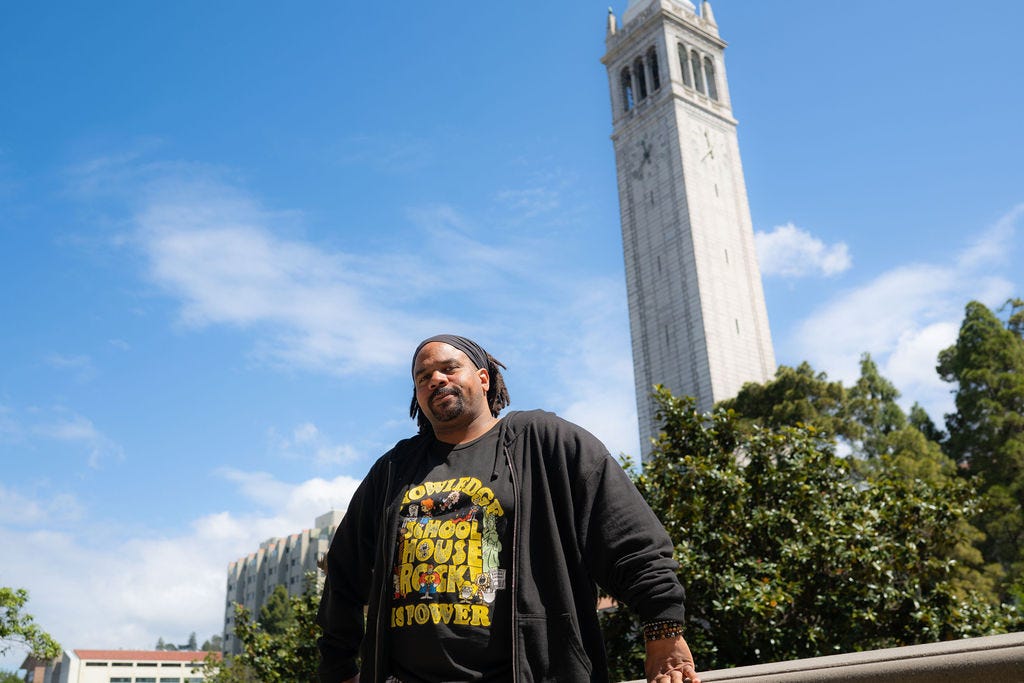
Charles Long graduated from U.C. Berkeley last month as the winner of the University Medal, the campus’s top award for a graduating senior. As you might expect from such an honoree, Long had a 4.0 GPA, professors who thought much of him, and numerous examples of extraordinary community service. In a letter of recommendation for the award, Laleh Behbehanian, a lecturer in Berkeley’s Sociology Department, wrote that Long’s ability to blend theoretical, analytic, and critical thinking placed him among the most outstanding students she’d encountered in her 23 years of teaching.
But what you might not expect is that Long is 43 years old, nearly twice the age of most of his fellow graduates. The road to his Berkeley graduation included foster care, homelessness, and several stints in California state prisons. Long was born in the Bay Area. After high school, he was arrested at 18 for an assault he says he did not commit. He spent months in jail awaiting trial and then accepted a plea deal; not because he was guilty, but because contesting the case felt more dangerous than surrender. He knew the price of losing at trial. Long’s father had fought a case in which he was offered one year in jail, lost, and received a ten year sentence in prison.
Long’s life after release from his first time in prison was hard. He was arrested and sent back to prison numerous times. Long has said that he processed the spirit and life he first lost and then later regained through storytelling, writing while incarcerated as much as 16 hours a day. Over time, he rebuilt that spirit and life. After his parole ended in 2007, he moved to Las Vegas, earned an IT certification, and launched a computer repair business out of his living room. “When the system denied me opportunity and dignity,” he wrote, “I created both for myself.” In our conversation, Long told me it wasn’t his extraordinary skills or character that changed his life, but the luck of a global pandemic. The lockdown gave him the breathing room to return to community college at 37, focus on school, and earn the grades that eventually brought him to Berkeley.
I spoke with Long in early June. We barely scratch the surface of his rich and complex story in this interview. Whether you choose to read the interview, to learn more about Long, or are inclined to just skip to the next thing, I encourage you to listen to his concise commencement speech. It will be a seven-minute investment of your time that will be well worth it. It will give you a taste of his wisdom and hope, and I think you will be better for it.
The interview has been edited for length and clarity.
- - -
Jonathan: Can you tell us a little bit about where you grew up and what the early part of your life was like?
Charles: I grew up all across the Bay Area. My parents met in Milpitas. When I was one, my mom was pregnant with who I call my big little sister (because she’s taller than me) and my dad went to prison. With a one-year-old and pregnant, my mom moved us to Oakland, and things just went downhill from there. My dad was locked up. My mom had a downward spiral with drug use. We ended up in foster care.
But then eventually, my mom finished her drug rehab, and it was really weird, because my dad got out of prison at the same time. So, we went from being in foster homes with no parents to having both our parents, which was really, really cool. Mom and dad kind of struggled, not even doing, like, working class jobs, but, like, less-than-working-class jobs. They were, like, 30 years old by that time. They were full-grown adults with four kids. They couldn’t have minimum wage jobs at McDonald’s; it wouldn’t work with four kids.
My mom started working at the post office. I think it was 1989; she still works at the post office to this day. She’s a union steward in Las Vegas. My dad went back to school. It was when computers were just starting to pop off. He went to school for network administration. During the late 90s, early 2000s, he was doing, like, network administration for a bunch of startups.
Jonathan: Where were you living then?
Charles: Before my dad got out of prison, we were living in Brookfield in East Oakland. When my dad got out, he moved us to Milpitas.
Jonathan: Is that where you went to high school?
Charles: We moved around but eventually ended up going back to Milpitas, and that’s where I went to high school.
Jonathan: Can you talk about what happened when you got arrested, and how you ended up going to prison?
Charles: There were kids going to summer school in Milpitas. Every day after summer school, kids were meeting up and fighting. It had been happening for a whole week or so. We had heard about it. Everybody would go to watch the fights. We were late to it one day, because we weren’t going to summer school. By the time we got there, the fight was already over. So, we were leaving, and the police pulled us over. They ended up arresting us, because somebody ended up dying at that fight.
We didn’t know that, because we missed the whole fight. We weren’t even there. They arrested me for conspiracy to murder. I was looking at 15-plus years to life. I kept asking if they could separate my case from the guys who were actually at the fight. I’m a guy that wasn’t even there, and my co-defendants are real murderers.
Jonathan: What happened?
Charles: They wouldn’t separate my case, and they end up convincing me to take a deal, because I was there for, like, two months, trying to get a speedy trial. They just kept saying no to everything. They scared me, like look, everybody next to you, they’re all getting 15 years. Do you want 15-plus years? Or do you just want two years?
Jonathan: Did you have a lawyer?
Charles: I had a public defender who was trying to convince me to take the two years. She wasn’t trying to do anything to prove that I was innocent. Her whole job seemed to be to convince me to take the two years.
Jonathan: Where did you go to prison?
Charles: I think the first time I went it was to Pelican Bay. I’ve been to, like, a bunch of prisons all throughout the state, because I had many parole violations, at least half a dozen.
Jonathan: How did you get through it?
Charles: You have to be at peace with yourself, and if worse comes to worse, you gotta be able to live with yourself and be able to pass the time. If you can’t live with yourself and you can’t pass the time, you might as well kill yourself.
Jonathan: What was life was like for you during the time you were going in and out of prison.
Charles: I was on parole for like, five years. I was in prison for three and a half of the five years, because it was just every little thing was giving me a one-year parole violation, and then you do six months on the year. So, it would be like, I’d get out for a few weeks, and then I’d go do six months. Then I’d get out for a few weeks, then I’d go do six months. Then I get out for a few weeks, then I’d go do six months. That’s just what kept happening, like, the whole five years of parole.
I was homeless. Maybe half of the time that I was getting parole violations, I actually committed a crime. I stole some shoes or some food. I think one time I stole a CD or something. Other times, I didn’t commit any crime. It was just random things that they wanted to violate me for.
It’s like, once you get in, you’re just stuck. It’s like sticky glue. Like a web. Once you’re in, it’s really, really hard to get out. Everything brings you back. Your whole perception of, like, the justice system changes. You become very anti-police.
Jonathan: So, what gets you out of that web, that sticky glue? How do you end up at Berkeley? How does that all happen?
Charles: Quarantine. COVID. If it wasn’t for quarantine, if it wasn’t for COVID, I would have never ended up at Berkeley.
Jonathan: Could you talk a little bit about that? What happened?
Charles: One thing I’ve noticed about all the stories about me, people post a lot of things like, oh, look at this guy; he’s Black, he’s formerly incarcerated, he was homeless, and then look what he did. And some people use that as a tool, like a weapon of violence against other people, like a pull-yourself-up-by-your-bootstraps kind of argument. Well, if he could do it, anybody can do it. Look what he did. That is so whack. It’s a series of fortunate events that got me to Berkeley. Literally a whole worldwide pandemic got me to Berkeley.
That we were all able to stay home during the pandemic and get those unemployment checks, that’s what got me back into community college. That’s what made it to where I could focus on school, instead of, like, working and all this kind of stuff. And then that’s when I started getting the good grades; and then that’s how I ended up transferring to Berkeley; and then it snowballed from there. But if it wasn’t for quarantine, none of this would have happened. So, it’s luck.
Jonathan: So you don’t want to spin your story as one of resilience and strength.
Charles: It was luck and opportunity. I mean, I’m good at what I do, I’m really good at school. But a lot of people are really good at school. I wouldn’t have made it here and had the opportunity to go to school if it wasn’t for luck and opportunity.
Jonathan: Talk about your time at Berkeley.
Charles: When I started off in school, I wanted to be a psychologist. In community college, I was a psychology major. But then I took my first social psychology class. I was like, wait a minute. Psychology research felt very manipulative. I wanted to do something that’s more effective for people who can’t afford to see a psychologist. I started taking sociology classes because it’s working with broader systems, and you’re affecting more people.
From community college, I had a psychology and sociology degree, and then I applied to Berkeley. It’s been fantastic ever since.
Jonathan: What was the work you did in San Quentin prison as part of your studies?
Charles: It was Teach in Prison, a student-run program. Essentially what we do is train Berkeley students to tutor those inside San Quentin. There are maybe 30 to 50 students. We get them cleared and trained. Everybody has a different role. I was kind of like the I’ve been there before kind of role. I was like, don’t be scared. It’s just a bunch of people like me, and Charles is fun. It’s like, it’s just me, that’s all. You’re gonna tutor a bunch of people just like me, so don’t be scared.
I also did debriefs with the students. When I got there, it was very lecture-heavy. We had never taken the time to ask the students, like, oh, how was your experience? There was so much rich content in their experience, and they were just letting it go to waste. I turned it into a more Socratic space.
Jonathan: Could you talk about your senior theses.
Charles: The first was originally titled Beyond the Stanford Prison Experiment. I was doing a study on the two programs that I was involved with, Teach in Prison and Incarceration to College, and I was measuring the empathy levels of all the students who do that kind of work. I took empathy scores on all the students that participated in the two programs. There are studies that say college students’ empathy has been in a decline for the last 30 years, right? And it’s just, observable, based on this one measurement of empathy. So, I gave my students the test, and my hypothesis was they were going to be, like, higher. It turns out empathy is like a muscle; it atrophies unless you use it.
I also did a significant research project on universities throughout the United States that offer BA or higher programs in prisons. I mapped them all out and found all the universities that have partnerships with prisons and offer BAs, and then I combined that with, like, key performance indicators. Like, how do you measure the quality of a higher education program in prison?
Jonathan: A lot of the people who will read this are involved in crafting sentencing policy. Do you have any thoughts about that?
Charles: Whatever thoughts I might have today might be different tomorrow. We all know there’s just a bunch of numbers that’s pulled out of somebody’s ass. Like, what’s relative, what’s worse, and what’s better? You know, you’ve got a housing crisis, and you’ve got people who terrorize the entire world, and you’ve got people who steal billions of dollars, and nobody goes to jail or prison. Then somebody steals a lawnmower from Home Depot, and they go to prison. Crime is dictated by the powerful and the rich.
So, if you’re asking me about sentencing, it’s going to be always in the favor of those who have the power to make the rules. And those who have the power to make the rules are those with the money. That’s why they can do criminal acts and not be criminalized. Somebody else does a survival crime, stealing a sandwich, and goes to prison.
Jonathan: If you could change anything about the criminal justice system, what would it be?
Charles: I don’t want to just throw random things out there. A lot of people just throw things out, and they’re not real solutions. So, I don’t want to throw anything out. I want to do some research and find some real answers that can be backed by something.
Jonathan: Two more questions. What do you think of all the attention that you’ve been getting lately?
Charles: I feel like it’s part of the job. It’s just my job, all of our jobs, everybody I work with, the students that tutor with me; faculty and staff that sponsor our research; everybody who’s kind of involved in this kind of work in one way or another.
I’m not alone. I’m like a hive mind. What’s the thing from Star Trek? What do they call it? The Borg? I don’t think of myself as an I. I think of myself as a we. I’m not really a front-of-the-camera type of person. I know a lot of people that I work with who are. They would have been so much better than me at this.
But I had the qualifications to go for it, so it was my responsibility to go for it. I know certain people, I call them politickers, they are charming, they love to be in front of the camera, they like attention. They would have loved this. They would have eaten it up. It would have been the best thing. But for me, I’m the type of person sitting here on my computer, typing. I like to be by myself. I wake up at 12, 1, 2 o’clock in the morning, because the world is quiet, and that’s when I get all my work done. I love to be alone.
So, the attention is not really my thing, but like I said, it’s part of the job. And it’s great for, you know, the greater purpose and the greater good, so I just suck it up.
Jonathan: What’s next for you?
Charles: I’m going to Africa for a year. This is gonna be my break. I did it. I graduated from U.C. Berkeley. Not only did I graduate from Berkeley, but I graduated as the University Medalist, the first Black valedictorian, the first formerly incarcerated valedictorian. I think the first former foster youth. I’m a lot of firsts, which is pretty fantastic. I get it.
But I get it in a, like, logical way, instead of, like, an emotional way. I don’t really feel it emotionally, I just kind of feel it more logically.
I want to go to at least five different countries in Africa. My fiancé lives there. I might build a house out there in her village. I then want to go to graduate school. I’m trying to figure out what programs I’m going to apply to and at what schools. I have about five months to think about it and figure out what’s next. I’m going to sit back and really just reflect on the last few weeks. Right now, I’m still, like, in it, so I can’t think yet. Once I get to Africa, and I’m thinking back, like, oh my gosh!
That’s where I’m at right now.
Jonathan: Thank you so much for talking with me. It was great to meet you, Charles. I wish you well. Please be safe on your travels.
Charles: Nice to meet you, too.
Another wonderful essay! Thank you, Jonathan!