The Sentencing Matters Substack: One Year In
We've surprised ourselves with this project; and we hope to expand and improve it in year two

A little more than a year ago, Doug, Steve, and I started this Substack as a new place for commentary and features about sentencing law, policy, and practice. The three of us have been studying, writing, and commenting on sentencing for decades. We teach sentencing courses in different law schools. We edit the Federal Sentencing Reporter, a quarterly academic journal that provides a deep dive into sentencing issues and trends, usually organized around a central topic or theme. Doug has written and published the Sentencing Law and Policy blog for over 20 years. It provides daily updates of sentencing news, including court decisions, sentencing commission policymaking and research report releases, relevant federal and state executive branch actions, events around the death penalty, and the work of academics, advocacy groups, and governmental and other non-governmental organizations focused on sentencing and criminal justice more broadly.
Back then, we thought what was missing from the current offerings was a forum for timely, longer-form commentary about sentencing law and policy and their connection to effective self-government, to justice, and to the larger world. Together with other related features, like interviews of some of the fascinating people involved in sentencing, we believed such a forum could bring an insight or two about sentencing and beyond, and maybe, too, help build a small community of learning.
The three of us are old-school enough to still believe there’s great value in this type of magazine content. The short form texts and video content of our time, like the kind you see on Tik Tok, Instagram, X, and Pinterest, are the stuff that certainly leads to engagement of a sort, but rarely, it seems, to genuine insights that stand the test of time. And then, of course, there is the brain rot that comes with social media and doomscrolling. Who wants to be part of that? We still cling tightly to the belief that spending 10 minutes or so reading a 1,500-word essay can be worth doing. And we know that for us, learning and growth comes in the hours it takes to write one.
Though unsure of the future, we know that reading and writing have been the foundation of culture around the world — and in the development of our liberal democracy, in particular — for a long time. The Enlightenment are not dirty words here. Whether liberalism and freedom will survive the social media, short-form video, and AI eras is anyone’s guess. The three of us may be just slowly going down with the pre-AI and pre-Twitter ship. But that’s the freedom that Substack and old age provide. We don’t expect all that many to actually want to consume our work product, although a topic like sentencing seems to be something everyone has an opinion on. As the great essayist Roger Rosenblatt reminds us, the important thing is to do the work (and that’s where the pleasure is too). Regardless, we know that the few of you who are reading this now are kindred spirits. Thank you.
Why We Continue to Think Sentencing Matters
On the subject of sentencing itself, we continue to think it matters and is worthy of serious consideration. As we’ve said before, at its core, sentencing is our government, acting on our behalf, inflicting pain and obligation on our fellow citizens as an accounting for those citizens’ misdeeds. Punishment, and the difficult issues it raises, is as old as Adam and Eve and as fresh as Puff Diddy. Formal punishment happens every week, thousands of times, in courts all across the country. And less formally, we’ve all been punished at some time in our lives. Some of us have imposed it too, even if only on our children. And more than that, the way our various governments —federal, state, military, and more — are meting out punishment these days ensures that the subject remains of genuine importance well beyond the personal right now.
When we do consider it seriously, we find that there are many challenges in and around the sentencing process. Some are as old as time. Utility versus retribution, for example. Some are new and developing as technology and our culture evolve. There is also innovation now and then in sentencing and corrections. The law reform experiment that was the sentencing reform movement of the late 20th Century is a cautionary tale for all would-be policy advocates and innovators. We find sentencing guidelines, for example, to be a genuinely valiant attempt to nudge judges to avoid dramatically different sentencing outcomes for similar crimes committed by similarly situated people; to bend our criminal justice system a bit more towards Equal Justice Under Law. But experience has shown that when guidelines are crafted poorly, they can do the opposite. One thing is for certain, there are rarely easy answers in sentencing.
As we contemplated this project, we had just enough arrogance to believe that we might create a public forum to air different views about sentencing and corrections — and some of their challenges — that simultaneously might be engaging, might lead to some new understanding here and there, and might ultimately also make our criminal justice system a bit more just. So off we went.
For our first six months — the second half of 2024 — our weekly essays focused almost exclusively and directly on sentencing. We wrote about the aspirational goals and values underlying sentencing guidelines; about how the federal sentencing guidelines have sometimes met and sometimes fallen short of those goals and values. We wrote about the federal Sentencing Commission and its processes, where we think those processes can be improved and where we think they serve the cause of great policymaking.
We commented on the Commission’s proposed guideline amendments, interviewed some great sentencing policy thinkers, including the first Chair of the U.S. Sentencing Commission and a recent presidential candidate who was earlier a governor and U.S. Attorney, found a sentencing lesson or two in the English Premier League and in some of Taylor Swift’s lyrics, and took a special interest in second look sentencing, including clemency and compassionate release. We thought about what an originalist take on sentencing and criminal justice more generally might look like, reviewed a few books, thought about the exercise of prosecutorial discretion after the campus Gaza protests, and a lot more.
January 2025 and Disruption
Then, six months ago, Donald Trump was sworn in as the 47th President of the United States. Love him or hate him, there’s no denying that President Trump is a disrupter. He is not restrained by conventional thinking or traditions or mores or kind intentions or even controlling Supreme Court precedents. I led a policy shop in the Criminal Division of the Justice Department during President Trump’s first term. His electoral victory in 2016 took even him by surprise. He had not then assembled a likeminded team and hadn’t prepared to govern. He turned to his family and to old Republican hands. The President’s son-in-law turned out to be a sentencing reformer. And the old Republicans generally restrained his worst instincts with their genuinely conservative take on most things. Not so for either in this second term.
President Trump has now assembled a team that is all-in both on his agenda and the means by which he intends to accomplish it. The assertion of expansive executive power. The deployment of the U.S. military to the streets of American cities as part of that assertion of power. Attacks on anyone who dares to oppose him, using all the means at his disposal as President of the United States, including prosecutorial and other government power, against them. Punitive tariffs on allies and adversaries alike.
These last six months of federal government action have, without question, been extraordinary. We published essays here to express concerns about certain steps our government was taking, if only to help us process what was happening. We felt it important to show camaraderie with the men and women across our government, our country, and the world, who have been the subject of the undeniable cruelty of many of our government’s actions, often for no underlying purpose beyond the expression and assertion of power. So there have been essays well beyond sentencing law and policy these last six months. They’ve looked at the way the President thinks and acts, the influence of professional wrestling on it, the search by so many for a Plan B in light of his actions, and even on how to rebuild our government after the teardown now underway is finally over.
Oddly enough, federal sentencing policy and policymaking have been rather stable these past six months. The President has not taken any personnel actions around the Commission. The Administration’s substantive comments to the Commission on the Guidelines and proposed amendments have not been unusual. The First Step Act has been embraced, at least rhetorically, by the Bureau of Prisons and its Director. There have not been new especially punitive measures taken in Congress, as one might have expected. Our latest sentencing essays have focused on the recently completed guideline amendment year, the recently completed Supreme Court term, the new Attorney General’s charging and sentencing policies, and how some states are considering expanding the use of the death penalty for child rape.
What We Hope for in the Coming Year
While we are generally pleased — and a bit surprised — with the Substack and how it has evolved over this last year, we think there are ways it can be improved to be more useful and enjoyable to those who read it, and to us too. Mostly we’d love to bring in new voices and new perspectives to the conversation. During the first year, we welcomed a number of guest essayists. Thank you to Jacob Schuman, Alan Vinegrad, Edgar Chen, Matthew Urfirer, Katie Kronick, and Norman Reimer for contributing your time and your thoughts to this forum. We are genuinely grateful that you joined us in this project. We’d love to add new voices too.
We’d especially like to include more on what’s happening in the state courts and state legislatures. Most criminal prosecutions are brought at the state level, and my particular history and focus has skewed our coverage almost exclusively to the federal system. We’d love to feature other academics, including younger ones, who are thinking about sentencing and corrections. We’d love to hear from those working at state sentencing commissions or in the state courts. State sentencing commissions are the hidden innovators in sentencing and corrections policy. And we’d be open to others too.
We’ve tried to create an aesthetic on this Substack that is serious, at times just a little bit snarky, but always gracious (my children tell me that I may not have succeeded at this). Our editorial standards, if you can call them that, are pretty straightforward. Factual accuracy is a core value; essays are in the 1,250 - 3,000 word range; critiques and opinions are encouraged but in a tone that is polite and generous to others, with some light sarcasm or mock ok, especially if directed at our government or others in power. If you’re at all inclined to contribute something, please let us know. And if you have ideas for improving this project, let us know that too.
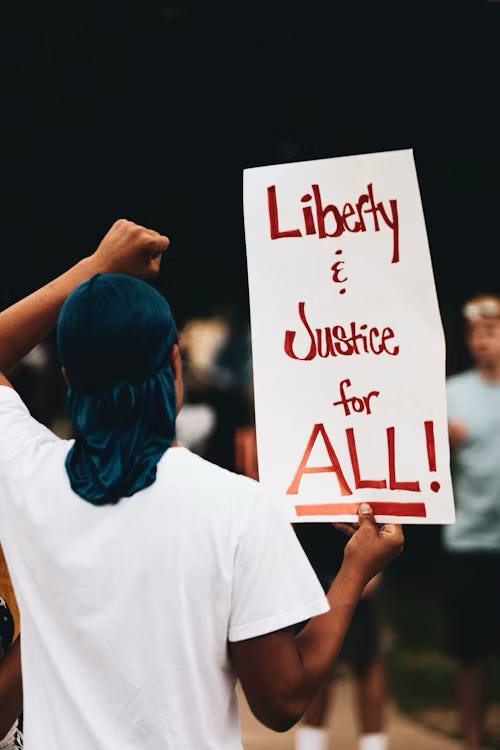
We hope for the coming year to bring some new thought-provoking ideas and some new topics too. And we hope to do it in an enjoyable way; and all of it in the service of liberty and justice for all.
- - -
P.S. We’ve gussied up our home page for the anniversary. Check it out — sentencing.substack.com.