
Undeniable Cruelty

Last week, the Department of Justice (DOJ) announced it was dropping its pending environmental enforcement lawsuit against Denka Performance Elastomer LLC. Denka is a Japanese company which runs a Louisiana petrochemical plant that was the subject of the lawsuit and that sits just a few hundred yards from Reserve, Louisiana, a majority-Black community.
The Denka plant makes synthetic rubber, the stuff that’s used for things like koozies to keep beer cans cold at football tailgates. And one consequence of its production is the emission of the carcinogen chloroprene and other chemicals in concentrations that create a highly elevated cancer risk, according to the original federal complaint filed by DOJ and the Environmental Protection Agency (EPA) during the Biden Administration. Children are particularly vulnerable, and there is an elementary school about a half mile from the plant. In the photograph below, you can see the petrochemical plant at the top of the photograph, and the adjoining neighborhood and the school at the bottom, separated by a stand of trees.

It turns out the risk of getting cancer in Reserve, Louisiana from air toxicity is among the highest of anywhere in the United States. Five census tracts within St. John’s Parish, the municipality to which Reserve belongs, are in the top 10 cancer risk zones in America. You may have heard that this area of Louisiana, along the Mississippi River, is often called Cancer Alley.
The Trump DOJ disagreed with the Biden Administration’s legal theory underlying the case and decided to dismiss it. It was the sad end of a decade-long campaign by the people of Reserve and their government to make things better for the community.
But it wasn’t good enough for DOJ simply to dismiss the case and then explain the disagreement in its press release. It chose to rub the dismissal in the faces of the Black residents of Reserve. “The dismissal fulfills President Trump’s day one executive order, ‘Ending Radical and Wasteful Government DEI Programs and Preferencing.’”
If you care to learn just a bit more about Reserve, the plant, and the various efforts over the years to address the pollution, here’s a video that was part of a Guardian report from several years ago about it all. The video includes footage of the people who live in Reserve –
Of course, any lawsuit’s complaint is just a series of allegations. And the story of the plant and the efforts to identify and address the toxic emissions over the last ten years or so certainly has different sides to it. The cost/benefit analyses can reach different conclusions about the right thing to do, depending, of course, on how you value the human lives impacted. And in our country, Denka is entitled to defend itself. So, it’s not at all surprising that this is how the firm representing the company and the plant summed up the dismissal of the case –
“We are extremely pleased to have achieved this result for our client. Defending the company and securing the dismissal exemplifies Bracewell’s excellence in integrating legal, government relations and strategic communications services to achieve successful outcomes on environmental matters for our clients,” said Jason B. Hutt, partner in Bracewell’s Washington, DC office and chair of the firm’s environment, lands and resources practice.
For someone who remembers when lawyering was considered a grand and noble profession, when legal giants led the firms in New York and Washington and presided over the judiciary, there’s so much to be embarrassed about in this statement. But this essay is about our government, which has a very different responsibility than Bracewell.
Whether you agree or disagree with the Biden Administration’s legal theory of the case, whether you agree or disagree with the framing of the case by the Biden Administration as furthering environmental justice, whether you agree or disagree with the dismissal of the case, one aspect of the Trump DOJ’s response to it seems undeniable. It has, with just a touch of glee, abandoned the people of Reserve – our fellow American citizens. Our brothers and sisters who are in danger are being left to fend for themselves. There’s nothing our government will do to help them.
And to ensure the people of Reserve know the not-so-small bit of pleasure that those in charge at the Justice Department are getting from dismissing the case, there is the reminder in the press release of how intertwined race is in all of this. “By ending United States v. Denka, the Justice Department and EPA are delivering on President Trump’s promise to dismantle radical DEI programs and restore integrity to federal enforcement efforts.” Someone at DOJ wrote those words and felt comfortable with the brutishness they represent. The press release was a gratuitous expression of cruelty.
As I was writing this essay, I received a text from a former colleague, who made a public service career of prosecuting sex crimes, about another cruel case dismissal. Her text included a link to this story from Bloomberg Law, and just two words in the text bubble: “It’s horrific.”
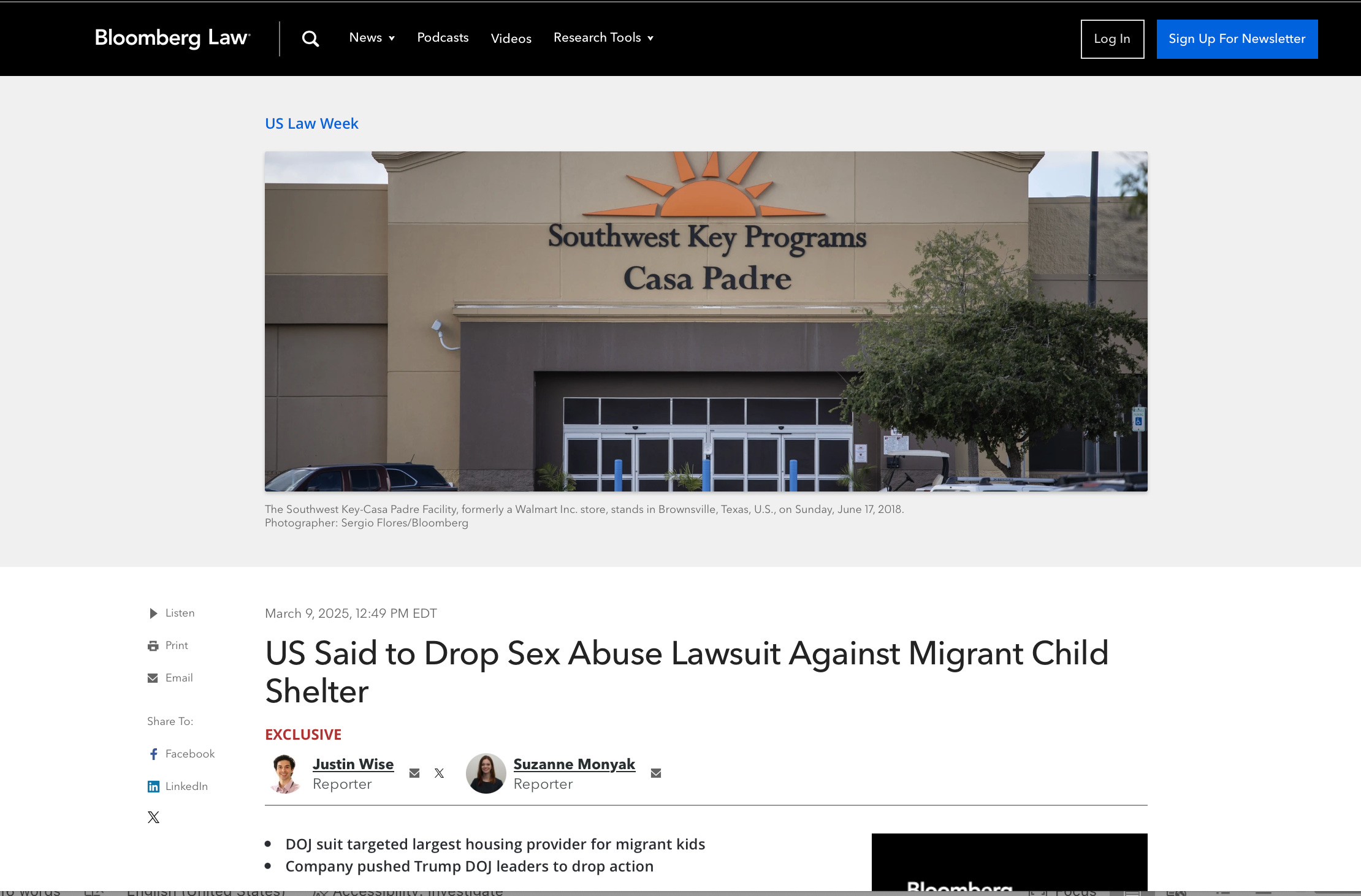
The story tells of the Administration’s plans to drop a lawsuit originally brought by the Biden Administration’s DOJ against Southwest Key Programs, a company that contracts with the federal government to house thousands of unaccompanied migrant children and “has received billions of dollars in federal grants” to operate facilities for the children. “The case is about children being raped and abused,” said Johnathan Smith, a former Deputy Assistant Attorney General in the DOJ’s Civil Rights Division. Another former Civil Rights Division lawyer summed up the dismissal this way: “[t]he United States is turning its back on children who are being abused in our country, and it’s disgusting.”
The last eight weeks have seen many government enforcement lawsuits dropped. We’ve all watched as pardons were granted to those who assaulted law enforcement officers defending the Capital of our country. Whole enforcement programs meant to protect the public, guarantee constitutional rights, and reduce corruption have been dismantled. Tens of thousands have been fired from their jobs for no particular reason beyond retribution and scorn. Our government has decided to scold and renounce Ukrainians fighting for their freedom after being attacked without provocation in their own country. And our President has reveled in imposing economic pain on our neighbors in Canada and Mexico. Maybe there’s some grand, coherent, utilitarian plan in all of this to produce some greater good for some greater number of people. But it doesn’t look like it.
Last week, Andrew Sullivan, in a Substack essay titled, The Bully in his Pulpit, reminded us of the cruelty that is part of our President’s character. “The best metaphor for Trump’s entire raison d’être is [an incident], when at just five years old, he was found throwing rocks at a baby: find someone weaker, first humiliate them, and then destroy them. And for Trump, this doesn’t have to lead anywhere. It is an end in itself. The bullying of others is what gives him life. He does it for those he favors as well as those he wants to destroy.”
What seems different in 2025 and this second Trump presidential term is that our President now has an army of bullies at his side. Don’t get me wrong, there was plenty of cruelty in Trump’s first term – think migrant family separation, first and foremost. But in the last eight weeks, it’s been an endless stream of cruelty. And it comes with a smile from the army imposing it.
It all reminds me of a painting that sits high up near the ceiling of the Attorney General’s conference room in Main Justice. It was painted by Leon Kroll, the son of Jewish immigrants who once taught at the National Academy of Design. The painting is titled Justice Defeated, and it shows a woman, prone on the ground, overwhelmed by a man in a black robe. The man holds a mask with a serene expression, but behind the mask his face is visible; cold, cruel, and vicious.

We are told that elections have consequences. True enough. But in recent days, the cruelty, which has been one consequence of the most recent election, is spreading and out of control. It would be far more comforting if our fellow Americans, in Congress and across the country, might push back against the cruelty done to our brothers and sisters, just because. I keep finding myself, in this time of Lent — a period, I thought, of greater moral clarity — coming back to “do unto others . . .” But it seems like the pushback may only happen when that cruelty spreads to the masses, like in the coming recession. As that recession edges closer, you can hear the President, our bully in the pulpit, starting to worry.