
What Compassionate Release Could Still Be
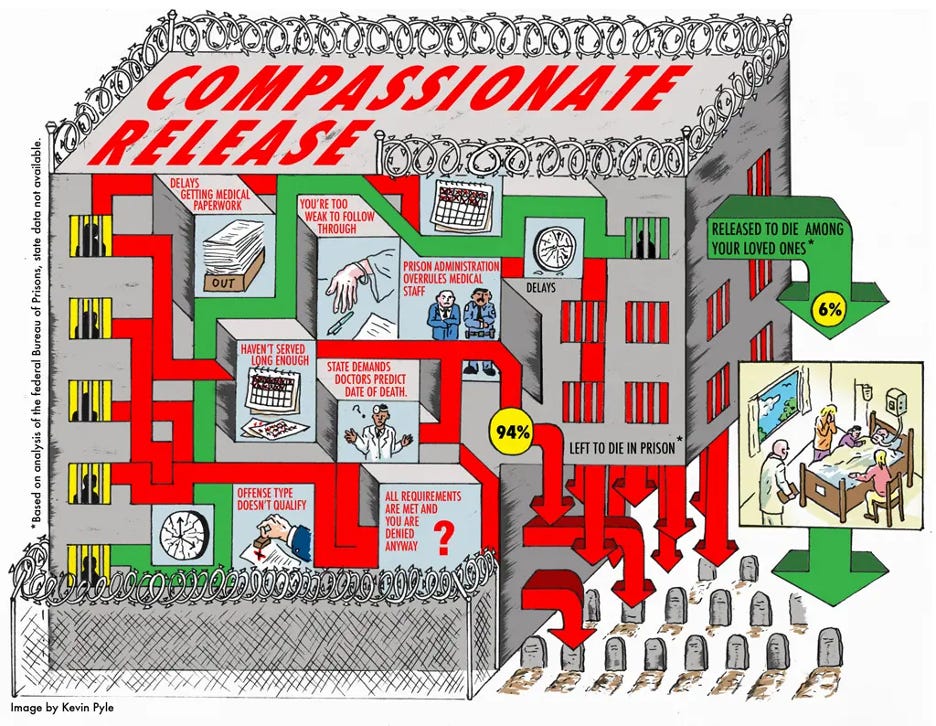
In Rutherford and Fernandez, Justice Barrett closes two avenues to compassionate release; but also shows us a new one

Last week, in Rutherford v. United States, the Supreme Court invalidated part of the U.S. Sentencing Commission’s policy statement that defines the “extraordinary and compelling” circumstances that permit a court to reduce a defendant’s otherwise final sentence and grant compassionate release. The invalidated guideline subsection, §1B1.13(b)(6), was promulgated in 2023 by the newly reconstituted Biden Sentencing Commission by a sharply divided 4–3 vote. That subsection says that it is an extraordinary and compelling circumstance when a defendant has served at least ten years of an unusually long sentence imposed under a sentencing law whose severity was later significantly reduced.
The Court’s slapdown of the Commission action was not only predictable and avoidable, but it was indeed clearly and publicly predicted, and a better alternative was put before the Commission by the Department of Justice. I was the Attorney General’s representative on the Commission in 2023, developed the alternative then, and pitched it to the other commissioners. I describe the history and dynamics of the 2023 amendment more fully in the essay, What Compassionate Release Might Have Been.

This essay reviews a bit of that history but then takes up the question of what should come next. For me, the answer to that question flows naturally and directly from Justice Barrett’s opinions in Rutherford and Fernandez v. United States, another compassionate release case handed down the same day as Rutherford. In Fernandez, the Court precluded the use of compassionate release to address legal errors otherwise addressable on appeal or on habeas under 28 U.S.C. § 2255.
In the opinions, Justice Barrett explains the Court’s take on the scope of compassionate release. More than that, though, she lays out a roadmap of how the Commission might now revise §1B1.13. The opinions have a couple of Swiftian Easter eggs inside too; cryptic hints that suggest the Commission could amend §1B1.13 along the lines of what the Department proposed as an alternative back in 2023 to create a true second look mechanism for many federal offenders. If the Commission did so, it would both reflect the Court’s understanding of the limits of compassionate release and adopt a better and more robust compassionate release policy.
- - -
Back in 2023, a sharp circuit split on whether changes in law could be an extraordinary and compelling circumstance suggested that the ultimate resolution of the split could go either way. Yet, any serious reading of the Supreme Court’s jurisprudence exposed the truth that enacting §1B1.13(b)(6) was risky, if not reckless for the Commission. The Court’s cases on the finality of criminal convictions, the strict limits on the availability of habeas relief, agency rule making, and Congress’s role in setting criminal penalties all pointed in one direction.
When the amendment was under consideration, I voiced my concern to the Commission that if approved, the issue would be headed to the Supreme Court. The Solicitor General’s Office and other DOJ appellate lawyers were eager to get the circuit split resolved, and they felt unusually determined about the position the Department had taken. We told commissioners that a Supreme Court confrontation was not in the Commission’s best interest or in the interest of sensible sentencing policy either. I developed a compromise proposal designed both to avoid a clash over the Commission’s authority and to produce what I thought was a better compassionate release policy. I believed then — and still believe now — that compassionate release can and should function as a genuine second‑look mechanism for offenders serving long federal sentences, but that it was not meant to be — nor should it work as — a workaround for otherwise applicable criminal procedure limits.
This is the compromise proposal I put to the Commission —
(b) Change in Law or Challenge to the Validity of a Conviction or Sentence.—Modification of a sentence based on retroactive application of a change of law or a challenge to the validity of a conviction or sentence is not an appropriate use of 18 U.S.C. § 3582(c)(1)(A). However, if a defendant otherwise establishes that extraordinary and compelling reasons warrant a sentence reduction, such factors may be considered in determining whether and to what extent to reduce a term of imprisonment or to impose a term of probation or supervised release.
(c) Extraordinary and Compelling Reasons.—Extraordinary and compelling reasons exist under any of the following circumstances or a combination thereof . . .
(6) Totality of Circumstances.—Occasionally, the totality of circumstances surrounding a person serving an unusually long imprisonment sentence will have changed so substantially, including as a result of rehabilitation, a new family circumstance, legal developments, or a combination of these and other factors, to constitute extraordinary and compelling reasons. In determining whether and to what extent a sentence reduction is appropriate under this paragraph, the court may consider the person’s (A) in-prison program participation, (B) mental, physical and emotional conditions, (C) work record in custody, (D) record of good works, (E) assistance to others, and (F) efforts to mitigate the effects of the offense.
The proposal would have authorized compassionate release in limited cases that did not involve extraordinary medical or family circumstances but did involve substantially changed personal circumstances. It would have been a step toward creating a second‑look mechanism for federal offenders serving extraordinarily long sentences, and, I believed, a more just and sensible policy than either what my colleagues at the Department or the Commission majority were advancing at the time. It would also have avoided the fight in the courts that ultimately ensued. The majority rejected the proposal outright, without any negotiation or counterproposal.
So, where does that leave us now that the Court has invalidated the Commission’s action? The Commission will have to revise §1B1.13 to comply with the Court’s decision. When it does, it should reexamine — and reimagine — §1B1.13 using the Court’s guidance as expressed in Justice Barrett’s opinions, and it should reconsider the proposal we at the Department of Justice put forward back in 2023. It may be too late for this iteration of the Commission to adopt anything (the terms of two of the five sitting commissioners expire soon); and the proposal might well be opposed by the current Department of Justice. But the Court has now supplied guidance for what good compassionate release policy might look like. In Rutherford and Fernandez, Justice Barrett explains succinctly what she and the Court majority believe compassionate release is and is not — what “extraordinary and compelling” can encompass, and what it cannot.
- - -
Here’s what the Court said compassionate release is not: it is not a workaround for procedural limits on correcting legal errors in a criminal case or a substitute for retroactive application of new laws that reduce penalties. As Justice Barrett explains, the very name of § 3582(c)(1)(A) — “compassionate release” — “highlights its focus on granting mercy rather than righting legal wrongs.” It is understandable that defendants tried to use the provision as a backstop in the absence of other remedies in these situations. But Rutherford and Fernandez have now clearly closed that path.
In her opinions, Justice Barrett also said clearly what compassionate release is: relief based on uncommon changes in a defendant’s personal circumstances that is a convincing reason to reduce that person’s sentence. Again and again in the opinions, she underscores that compassionate release is not about the crime itself, the proof of that crime, or changes in the law governing either, but rather about how a defendant’s personal circumstances have changed and who that defendant has now become. For example, she says “[t]he role of the Bureau of Prisons [in the compassionate release process] reflects the statute’s focus on a defendant’s personal circumstances — his advanced age, safety risk, illness, rehabilitation, and the like.” Fernandez (slip op. at 11) (emphasis added). Easter Egg #1. For decades, she notes, the Sentencing Commission has likewise tied the availability of compassionate release to a defendant’s personal circumstances, not to legal error.
As to the meaning of “extraordinary and compelling,” Justice Barrett again is clear. “While the terms ‘extraordinary’ and ‘compelling’ leave room for judgment, they are not so flexible as to encompass any consideration.” “‘Extraordinary’ means ‘most unusual,’ ‘far from common,’ and ‘having little or no precedent’ . . . (‘[o]ut of the usual or regular course or order’). ‘Compelling’ means ‘tending to convince or convert by or as if by forcefulness of evidence’ . . . (‘irresistible, demanding attention, respect’).” Barrett rejects the idea that the required finding of extraordinary and compelling is, “as petitioners seem to believe, a free-for-all. It is a distinct analytical step that imposes independent and ascertainable limits on access to compassionate release.”
On what is compelling, Justice Barrett reasons that —
[a]n argument that is compelling in one context is not necessarily so in another; the force of an argument depends on what it seeks to justify. For instance, a 25th wedding anniversary is a convincing reason to shorten a business trip, but it is not a convincing reason to shorten a prison sentence. So here, we do not ask in the abstract whether a challenge to the validity of a conviction is ‘compelling.’ We ask whether it is an especially convincing reason to grant the relief sought: compassionate release from prison.
So, the high-level roadmap to qualifying for compassionate release is —
A defendant’s personal and/or family circumstances must be unusual or uncommon; and
Those circumstances must be a convincing reason to reduce a sentence.
Within this roadmap, the Commission is free to roam as it defines “extraordinary and compelling.”
But perhaps most importantly in scoping out compassionate release, Justice Barrett finds great import in the admonition in 28 U.S.C. § 994(t) that “[r]ehabilitation of the defendant alone shall not be considered an extraordinary and compelling reason.” On the one hand, she reasons that Congress’ choice to rule out one consideration does not mean that all other considerations are fair game. She imagines a dietician cautioning her patient that “[p]asta alone is not an acceptable dinner.” “This advice,” Barrett says, “does not license any meal besides standalone pasta,” and certainly not fried chicken. She reasons from this that ruling out rehabilitation alone as a justification for compassionate release, as Congress did, “suggests nothing about what other reasons might qualify as ‘extraordinary and compelling.’”
At the same time, though, Barrett recognizes that Congress’s language allows rehabilitation to be considered in the compassionate release analysis so long as it is accompanied by other factors that make a defendant’s personal circumstances extraordinary and compelling. Rehabilitation cannot stand alone, she reasons, but it can be part of the mix. As she puts it in Fernandez, “Congress has permitted the Sentencing Commission to treat a defendant’s rehabilitation as a relevant consideration in granting compassionate release.” Easter Egg #2. Pasta alone may not be what our dietician recommends; but a minestrone with pasta and lots of veggies is ok.
With these two Easter eggs, Barrett effectively endorses a totality of circumstances approach for determining extraordinary and compelling personal circumstances of the sort we at the Department of Justice proposed in 2023. In testimony before the Commission then, one witness summed up the views of many when she said judges must look at “the entire constellation of circumstances” that might justify a reduction in sentence. Many witnesses testified about offenders who warranted a sentence reduction and spoke mostly about how the offenders had made extraordinary progress toward changing their lives and were very different people than the ones who were originally sentenced. The narrative was inevitably about reform and redemption. This reality was behind our 2023 proposal, and in light of Justice Barrett’s opinions, that Department proposal looks rather plausible, if not compelling, and certainly warrants its own second look by the Commission.
Here is an updated version of the proposal that would bring §1B1.13 more in line with Rutherford and Fernandez and, I believe, provide a sounder framework for compassionate release (new language in bold) –
(b) Change in Law or Challenge to the Validity of a Conviction or Sentence.—Modification of a sentence based on retroactive application of a change of law or a challenge to the validity of a conviction or sentence is not an appropriate use of 18 U.S.C. § 3582(c)(1)(A). However, if a defendant otherwise establishes that extraordinary and compelling reasons warrant a sentence reduction, such factors may be considered in determining whether and to what extent to reduce a term of imprisonment or to impose a term of probation or supervised release.
(c) Extraordinary and Compelling Reasons.—Extraordinary and compelling reasons exist under any of the following circumstances or a combination thereof . . .
(6) Totality of Circumstances.— Occasionally, the totality of circumstances surrounding a person
serving an unusually longwho has served more than 50% — and at least four years — of their imprisonment sentence will have changed so substantially, including as a result of rehabilitation, new family circumstances,legal developments, age, medical condition, or a combination of these and other personal circumstancesfactors, to constitute extraordinary and compelling reasons. In determining whether and to what extent a sentence reduction is appropriate under this paragraph, the court may consider the person’s (A) in-prison program participation, (B) mental, physical and emotional conditions, (C) work record in custody, (D) record of good works, (E) assistance to others, and (F) efforts to mitigate the effects of the offense.
The amended proposal would reorient the Commission’s approach in two related ways. First, the revised proposal would make clear that a change in law or a challenge to the validity of a conviction or sentence, standing alone, is not an appropriate basis for compassionate release under § 3582(c)(1)(A). That is, it would close the door to using compassionate release as a de facto substitute for retroactivity or habeas. At the same time, it would expressly permit courts to consider those legal developments once a defendant has already shown “extraordinary and compelling reasons” on other grounds, using changes in law or questions about validity only to calibrate whether, and how much, to reduce a sentence.
Second, new subsection (c)(6) would embrace a true totality of circumstances standard. It would recognize that, in rare cases, the overall picture surrounding a person serving an unusually long sentence — including that person’s rehabilitation, new family circumstances, and aging or health changes — can add up to something extraordinary and compelling. The listed factors — program participation, in-prison work record, good works, assistance to others, and efforts to mitigate harm — would guide courts in assessing those cases, providing a structured but flexible framework that remains faithful to congressional design. The proposal also changes out the “unusually long” language in light of a recent Eighth Circuit decision that found ambiguity in that phrase (discussed more fully in the essay, Is a Life Sentence “Unusually Long?”)

The proposal is worth a second look and serious consideration.
- - -
Two additional points — First, whether or not the Commission adopts this amended proposal, it should consider creating a data‑driven implementation strategy with the Bureau of Prisons (BOP). The Commission and BOP each sit on rich but separate datasets — sentencing and criminal‑history information, guideline calculations, and appellate outcomes on one side; disciplinary records, program completion, medical and aging indicators, work history, and reentry‑planning data on the other. Working together, they could responsibly use artificial intelligence and other analytics to flag people who appear to be strong candidates for compassionate release under the revised standard or clemency. Properly designed, these tools would not replace defendant requests and BOP consideration; they would serve as a new screening mechanism, surfacing cases that might otherwise be overlooked. An earlier Substack essay suggested there may be many overlooked cases.

Used well, this kind of collaboration could advance both public safety and fairness. Models trained on historical outcomes — and rigorously audited for bias — could help flag people who have shown sustained rehabilitation, minimal disciplinary history, strong community ties, and a low predicted risk of reoffending. For example, the system could automatically alert BOP and the Commission when a person serving an unusually long sentence has served a set percentage of their term, completed key programming, and maintained a pattern of positive adjustment, prompting a closer, human review for compassionate release or clemency. The same tools could also reveal systemic patterns — groups of similarly situated individuals who are consistently granted or denied relief — and thus inform future guideline amendments and policy choices.
Any AI‑driven approach would need clear safeguards. The Commission and BOP should be transparent about what data they use, how models are built, and how they are validated; they should ensure that no model encodes or amplifies racial, socioeconomic, or geographic inequities; and they should make explicit that algorithmic outputs are advisory, not dispositive. With those constraints in place, the Commission can do more than simply conform — and repair — §1B1.13 after Rutherford and Fernandez. It can help build a modern, empirically grounded second‑look system — one that uses the best available tools to identify the right cases at the right time, while leaving ultimate authority where it belongs: with judges, the Commission, and the President’s clemency power.
Second, California already offers a model of prison‑initiated review of long sentences that the federal Commission should study closely. Under California Penal Code § 1172.1, the Department of Corrections and Rehabilitation (CDCR) operates a Recall and Resentencing Recommendation Program in which prison officials proactively identify incarcerated people whose sentences may no longer be in the interest of justice and refer them back to the sentencing court for possible recall and resentencing. CDCR relies on case‑records data and staff who know the person’s conduct to flag candidates based on factors such as legal changes, evidence of “exceptional conduct,” disciplinary history, and rehabilitative progress; those cases are then evaluated and, if approved by a higher official, formally recommended to the court. A federal analogue would not replace compassionate release or clemency, but it would institutionalize a practice of prison‑initiated screening: using Bureau of Prisons data and staff assessments to identify people who appear to meet the Commission’s “extraordinary and compelling” standard and to route those cases to courts and/or the Executive for fuller consideration.
Jonathan, you are a priceless resource for sentencing policy!